To the Gate of Hell by Armin Böttger
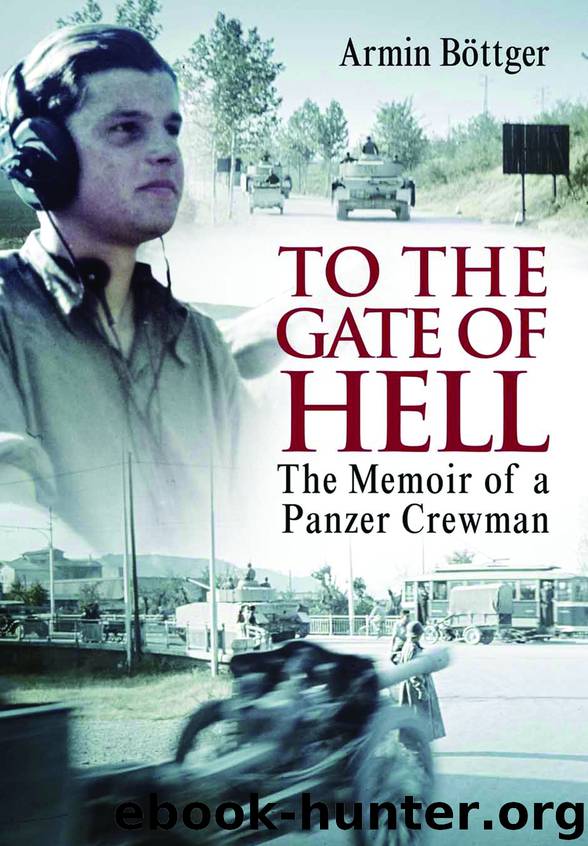
Author:Armin Böttger
Language: eng
Format: epub
ISBN: 9781783033485
Publisher: Frontline Books
Published: 2013-02-19T05:00:00+00:00
Chapter 15
Awards and Decorations: Pro Virtute et Merito
The Iron Cross developed during the war to become one of the most important rewards for one’s involvement in battlefield endeavour. Simple soldier and officer both wanted to wear a decoration so that in the relationship between superiors and subordinates, and men of equal rank too, one might claim to be the better soldier, even a privileged man. The sergeant without the Iron Cross I lacked an important decoration as against the sergeant who had it. In my squadron there was a corporal, later promoted to sergeant, who had the Iron Cross I as commander of a panzer and also wore the Silver Wound-Badge for five wounds. He used to say quite freely, but he meant it, that he was hoping for one more “light” wound so that he could wear the Gold Wound-Badge and everybody would think, “This is a hero”. In this connection I refer the reader to J. C. Fest’s question as to what was striking about Hitler in 1933: he had the Iron Cross I, a high award for a mere private soldier.4
It is interesting to note that the institution and renewal of the Iron Cross from 1813, 1870 and 1914 was a Prussian decoration while that of 1939 was an order of the German Reich. With the 1939 renewal the difference between the Iron Cross as an award for personal bravery and for services at command level fell away. Previously the distinction had been identified by different medal ribbons for fighting and non-fighting men respectively. Accordingly one could not tell from the Knight’s Cross of the Iron Cross of the Second World War whether the wearer had been awarded it for bravery or for being a successful commander.
In most cases it was only a man’s rank which indicated the reason for the award. A private soldier for example could hardly be decorated for successful command nor a general or senior officer – with the exception of some Luftwaffe officers – for service at the front involving a weapon. Thus no private or NCO won the Knight’s Cross of the Iron Cross with Oak Leaves and Swords.
A certain hierarchy of awards was recognizable throughout. The NCO received the Iron Cross II for taking part in a certain number of engagements in the field, the sergeants and officers of junior rank the Iron Cross I, and from squadron commander upwards after successful actions the Ehrenblatt clasp, the German Cross in Gold or even the Knight’s Cross. Later the Oak Leaves would follow and for a general who had commanded an army for a long period, the Swords. Bravery was also measured by the Silver or Gold Close-Combat Clasp (fifty and seventy-five engagements respectively) and the Panzer Combat Badge for fifty and seventy-five engagements respectively, rightly considered the highest awards for bravery.
An order might be awarded as a parting gift. When Hitler summoned Generalfeldmarschall von Manstein, Commander-in-Chief Army Group South, to the Berghof, he informed him that the period of attacks was over and he was therefore transferring Manstein’s command to Feldmarschall Model.
Download
This site does not store any files on its server. We only index and link to content provided by other sites. Please contact the content providers to delete copyright contents if any and email us, we'll remove relevant links or contents immediately.
| Africa | Americas |
| Arctic & Antarctica | Asia |
| Australia & Oceania | Europe |
| Middle East | Russia |
| United States | World |
| Ancient Civilizations | Military |
| Historical Study & Educational Resources |
The Radium Girls by Kate Moore(12036)
100 Deadly Skills by Clint Emerson(4932)
Rise and Kill First by Ronen Bergman(4797)
The Templars by Dan Jones(4695)
The Doomsday Machine by Daniel Ellsberg(4493)
The Rape of Nanking by Iris Chang(4224)
Killing England by Bill O'Reilly(4008)
Stalin by Stephen Kotkin(3973)
Hitler in Los Angeles by Steven J. Ross(3949)
12 Strong by Doug Stanton(3554)
Hitler's Monsters by Eric Kurlander(3352)
Blood and Sand by Alex Von Tunzelmann(3207)
The Code Book by Simon Singh(3197)
Darkest Hour by Anthony McCarten(3137)
The Art of War Visualized by Jessica Hagy(3014)
Hitler's Flying Saucers: A Guide to German Flying Discs of the Second World War by Stevens Henry(2759)
Babylon's Ark by Lawrence Anthony(2686)
The Second World Wars by Victor Davis Hanson(2529)
Tobruk by Peter Fitzsimons(2521)
